Landscaping & material estimates
Gravel Calculator
Calculate how much gravel you need from your measurements — it works the same way for crushed stone, river rock, landscape rock and sand. Add your supplier’s density to estimate weight and compare quantities with your quote.
- Multiple areas
- Cubic yards & estimated tons
- Imperial & metric
Ordering basics
Volume, weight and order quantity are different
Keep the three numbers separate and most ordering mistakes disappear.
01 · Volume
Space occupied
Calculated from length, width and depth. Measured in cubic yards. It does not depend on the type of stone.
02 · Estimated weight
Volume × bulk density
Needs the supplier’s density for that product and condition. Moisture, rock type and grading all change it.
03 · Purchase quantity
What you actually buy
Your requirement after the supplier’s minimum order and selling increment. Ask which unit and step they use.
Worked example
How to calculate gravel volume step by step
30 ft × 9 ft at 4 in loose depth with an optional 5% allowance. Calculated by the same engine as the tool above.
- Step 1 Depth to feet 4 in ÷ 12 = 0.3333 ft
- Step 2 Cubic feet 30 × 9 × 0.3333 = 90.00 ft³
- Step 3 Cubic yards 90.00 ÷ 27 = 3.33 yd³
- Step 4 Optional 5% allowance 3.3333 × 1.05 = 3.50 yd³
- Step 5 Weight at a supplier density 3.50 × 2,700 = 9,450 lb 2,700 lb/yd³ is an illustrative value, not a preset. Use your supplier’s figure.
- Step 6 US short tons 9,450 ÷ 2,000 = 4.725 tons
If 4 in were the finished depth and your supplier’s factor were 1.20: 3.33 yd³ × 1.20 = 4.00 yd³ loose, + 5% = 4.20 yd³ (5.67 short tons at the same illustrative density).
Volume
yd³ = L (ft) × W (ft) × D (in) ÷ 324
Weight
US short tons = yd³ × density (lb/yd³) ÷ 2,000
Material types
Use the density for the product you are buying
Product names alone do not tell you the weight. Ask the supplier for the bulk density they use for billing.
-
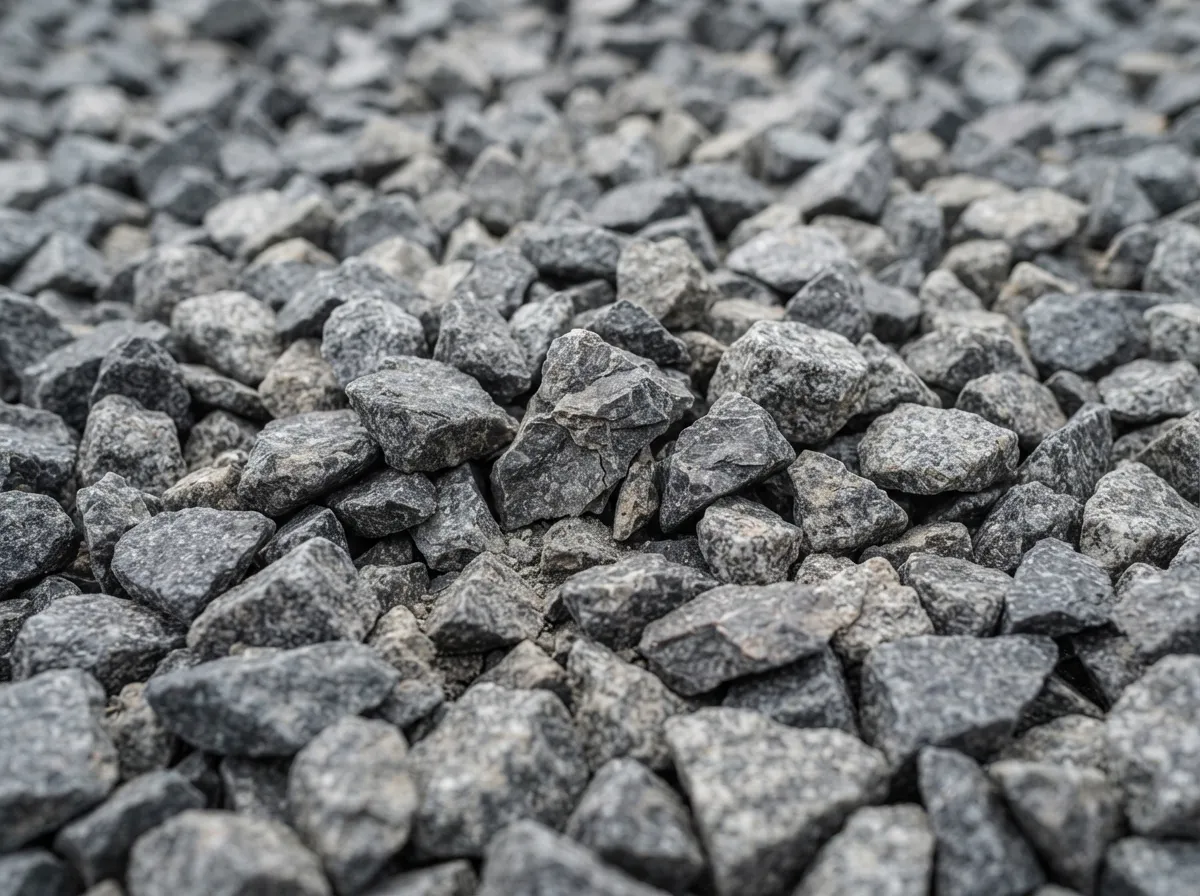
Crushed stone
Angular pieces that lock together when compacted. Often sold with or without fines, which changes how densely it packs.
-
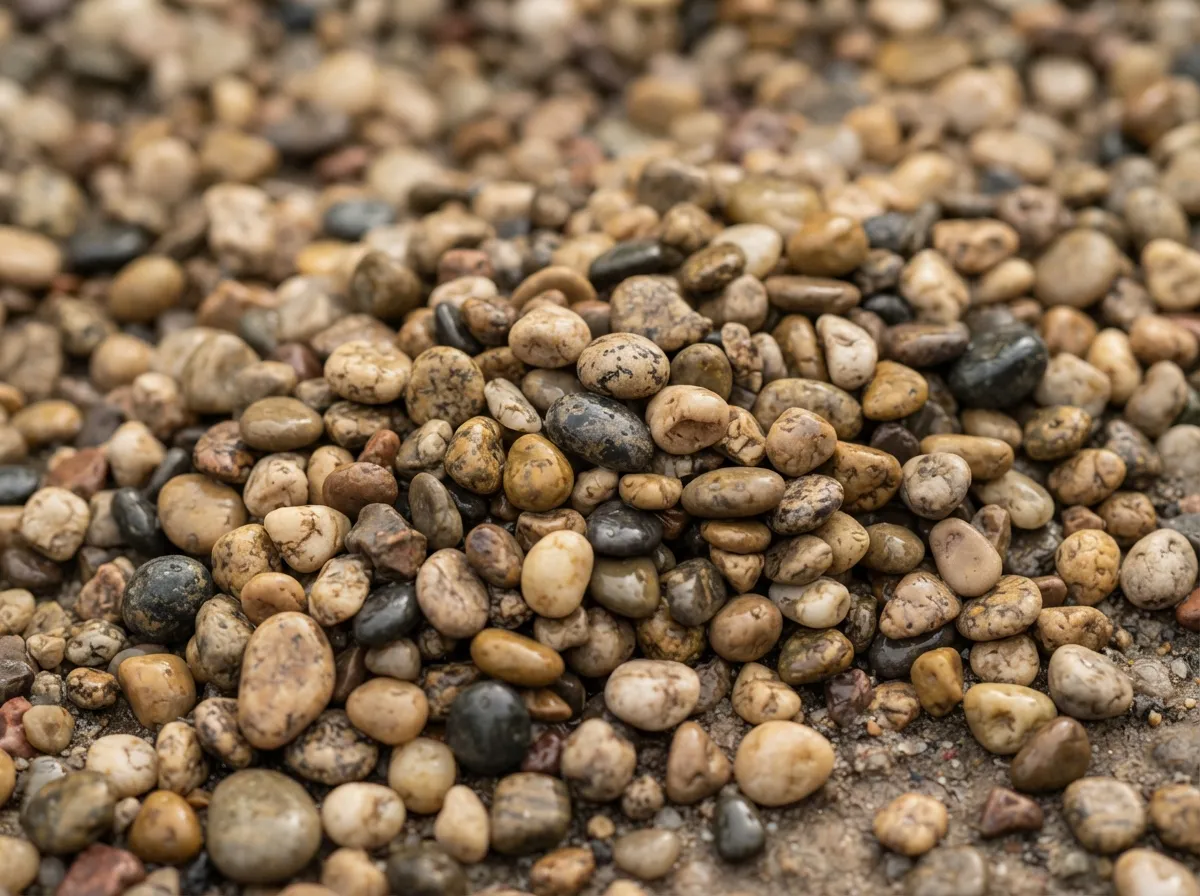
Pea gravel
Small, rounded stones that do not interlock the way crushed stone does. Common for paths and drainage.
-
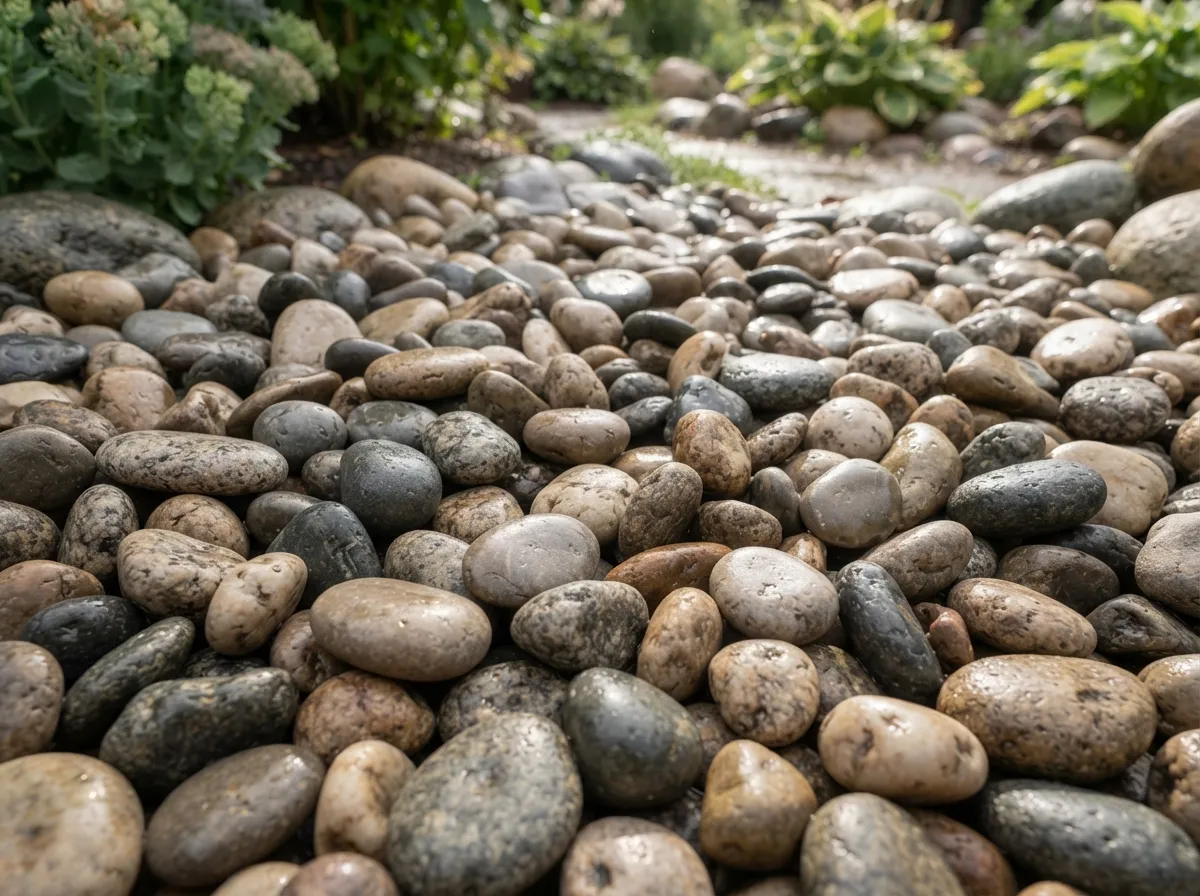
River rock
Larger rounded stones used decoratively. Larger sizes leave bigger gaps between stones.
We do not publish density presets because values vary by quarry, grading and moisture. Confirm the figure with your supplier or on the weight ticket.
Before you order
Six questions to ask your supplier
- 1 Which exact product and grading?For example clean stone versus a base material with fines, and the size range.
- 2 Do you price by the cubic yard or by the ton?And is it a US short ton (2,000 lb) or a metric tonne (1,000 kg)?
- 3 What bulk density do you use?The lb/yd³ (or kg/m³) figure they use to convert between yards and tons.
- 4 What loose-to-finished factor do you suggest?Only needed if your depth is the finished, compacted depth.
- 5 What is the minimum order and the selling increment?For example a minimum of 1 yd³ in half-yard steps.
- 6 What does delivery cost, and where can the truck tip?Check access, ground protection and any extra charges.
This calculator estimates quantities from your inputs. It does not determine engineering depth or vehicle payload safety.
Next steps
Related tools and measurement guides
Calculators
Questions
Gravel volume and weight questions
How much gravel do I need?
Multiply the area in square feet by the depth in feet (inches ÷ 12) and divide by 27 for cubic yards. A 30 ft × 9 ft area at 4 in is 270 × 0.3333 = 90.00 ft³, or 3.33 yd³ before any allowance.
How do I convert cubic yards of gravel to tons?
Multiply cubic yards by your supplier’s bulk density in lb/yd³, then divide by 2,000 for US short tons. With an illustrative 2,700 lb/yd³: 3.50 × 2,700 ÷ 2,000 = 4.725 tons. Different stone, grading and moisture give different densities, so there is no single conversion.
What is the difference between loose and compacted volume?
Loose volume is the material as delivered and spread. When a layer is compacted, particles pack closer and the same material occupies less space. If your depth is the finished, compacted depth, you need more loose material than the finished volume.
Is a 1.20 multiplier the same as 20% shrinkage?
No. If loose material loses 20% of its volume when compacted, 100 loose yd³ becomes 80 finished yd³. Going back, loose = finished ÷ 0.80 = 1.25 × finished. A 1.20 multiplier corresponds to about 16.7% loss. That is why this calculator asks for your supplier’s multiplier rather than a shrinkage percentage.
Does the supplier factor include my extra allowance?
Ask your supplier. The calculator applies their factor first and your allowance second, each once, and shows both lines so you can check nothing is counted twice.
Can I use this for a driveway?
You can calculate the volume and weight for any depth you enter. The calculator does not decide how thick a driveway base or surface should be — that depends on soil, loads and local practice, so follow your contractor’s or engineer’s specification.
Can I carry gravel in my own vehicle?
Check the payload rating in your vehicle’s documentation and compare it with the estimated weight from your supplier’s density. Gravel is heavy, so a small volume can reach a vehicle’s limit.